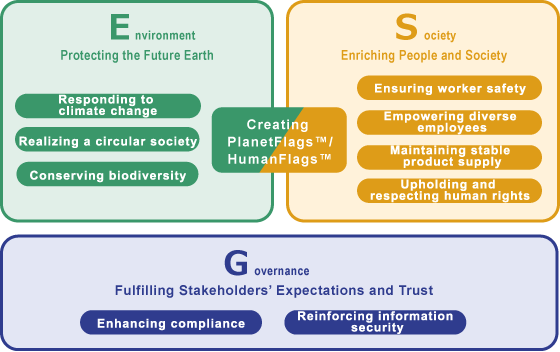
The Nitto Group identified its material issues for sustainability in 2019 and have strengthened its sustainability activities across the entire group in a bid to simultaneously solving social issues and creating economic value.
In 2026, following changes in the internal and external environment, as well as rising expectations from stakeholders, we reviewed and redefined prioritized issues in line with the changing social challenges.
Going forward, we will aim to be an “Essential ESG Niche Top Company” by 2030.
To that end, we will evolve our sustainability management to make it more effective as an “essential” entity for the global environment, humankind, and society, further driving sustainable growth.
 |
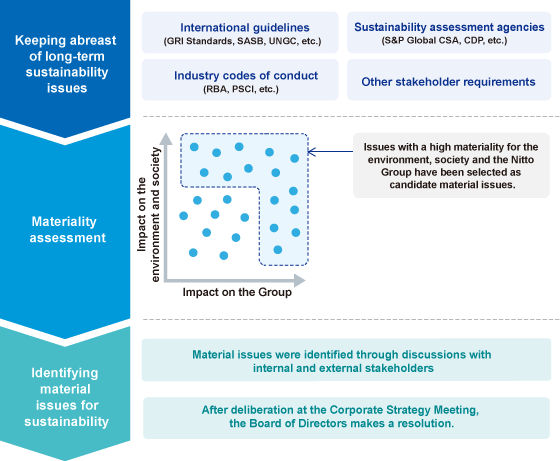
The Group selects short-, medium-, and long-term sustainability issues in conducting business activities, and assesses the impacts that these issues have on the environment and society, as well as on the Group (financial impacts of risks and opportunities). Following discussions with internal and external stakeholders, we then identify items of high importance as material issues. After deliberation at the Corporate Strategy Meeting, finally the material issues are made a resolution at the Board of Directors meeting.
Taking into account changes in the internal and external environment, we assess the need for review of our material issues annually, and update the details as needed. Further, we reassess the importance of each issue at least once every three years. In implementing reviews regularly, we identify impacts, risks and opportunities associated with each issue to align with the medium-term management plan and reflect them in our business plans.
 |
| Material Issues for Sustainability | Ideal State | Target State 2030 | Impact | ■ Risks / 〇 Opportunities |
|---|---|---|---|---|
| Responding to climate change | Protecting the Future Earth | We promote decarbonization management, the establishment of a foundation prepared for diverse climate-related risks, and innovation that solves societal issues. By aiming for zero environmental impact over the entire supply chain, we contribute to the realization of a decarbonized society. |
| ■ Increase in raw material costs, procurement costs, and transportation costs due to soaring fossil fuel prices associated with the strengthening of laws and regulations and market changes ■ Increase in taxation costs due to the increased introduction of carbon taxes and GHG emission levies associated with the strengthening of laws and regulations ■ Increase in capital expenditures due to the development and introduction of high energy-efficient technologies 〇 Increase in revenue through the development and sale of products and services that meet the growing demand for low-carbon products |
| Realizing a circular society | We contribute to the realization of a sustainable circular society throughout the entire supply chain by promoting resource efficiency, environmental impact reduction, and business creation. |
| ■ Increase in raw material costs due to switching to raw materials contributing to the realization of a circular society, and suspension of operation due to procurement difficulties ■ Increase in waste disposal costs due to refusal of waste collection 〇 Decrease in raw material procurement costs through the efficient use of raw materials 〇 Decrease in waste collection and recycling costs through waste reduction, and providing of valuable waste at high prices | |
| Conserving biodiversity | We contribute to nature positive that aim to restore and regenerate nature toward realizing a sustainable society by collaborating with all stakeholders. |
| ■ Increase in taxation (operating) costs due to the strengthening of regulations on air pollutant emissions ■ Suspension of operation due to the unavailability of water resources necessary for operations 〇 Increase in revenue through the development and sale of products and services that contribute to the efficient use of water resources | |
| Creating PlanetFlags™/HumanFlags™ | In our three focus domains of “Digital Interface,” “Green Tech,” and “Human Life,” we are creating essential value to the global environment, human society, and our customers and industries. |
| 〇 Increase in revenue through the development and sale of products and services that meet the growing demand for products that contribute to sustainability 〇 Creation of new markets and new businesses through the accumulating new technologies and know-how via the development of PlanetFlags™/HumanFlags™ | |
| Ensuring worker safety | Enriching People and Society | With the aim of reducing all types of accidents and injuries to zero, we are committed to creating a safe and healthy work environment for all people working for the Nitto Group. |
| ■ Suspension of operation, business improvement orders, or suspension orders associated with the occurrence of critical accidents and injuries |
| Empowering diverse employees | We are committed to creating an environment in which diverse talent with a wide range of values and perspectives is respected and can thrive, while fostering talent capable of driving global business growth. |
| ■ Loss of business know-how and decreased revenue resulting from employee turnover caused by inadequate performance evaluation. 〇 Enhancement of business competitiveness through improved individual skills and new value creation brought about by employee skill development 〇 Increase in overall employee productivity and motivation, as well as creation of innovation by forming an environment where diverse people can play an active role | |
| Maintaining stable product supply | Aiming to remain a company trusted and chosen by stakeholders, we are engaged in high-quality manufacturing through continuous improvement and sustainable collaboration across the entire supply chain. |
| ■ Suspension of operations due to supply shortages of raw materials and supplies, and increase in costs for searching for alternatives and technical development ■ Increase in product recall costs associated with the occurrence of recalls due to quality problems ■ Decrease in revenue due to decline in reputation caused by the occurrence of quality problems and market withdrawal | |
| Upholding and respecting human rights | By preventing or reducing the negative impacts of our business activities on human rights, we contribute to realizing a society where everyone can work with peace of mind through corporate activities that respect human rights. |
| ■ Decrease in revenue due to business suspension orders associated with human rights violations, or an increase in legal costs due to litigation ■ Reputational damage related to respect for human rights and subsequent employee turnover 〇 Increase in revenue through the acquisition of new customers driven by an improved reputation resulting from respect for human rights | |
| Enhancing compliance | Fulfilling Stakeholders’ Expectations and Trust | While promoting the understanding and practice of the Business Conduct Guidelines among every employee, we are mitigating compliance risks and strengthening systems for early detection and correction of misconduct to prevent occurrence, contributing to sustainable growth and earning society’s trust. |
| ■ Reputation damage and loss of public trust due to compliance violations |
| Reinforcing information security | While maintaining the trust invested in us by our clients and contributing to the stability of society, the Nitto Group fulfills its responsibilities to society through our information security management activities. |
| ■ Increase in costs due to business delays, recovery costs, and compensation associated with system shutdowns caused by cyberattacks ■ Loss of public trust due to leakage of confidential information 〇 Acquisition of public trust through the strengthening of information security |
| Material Issues for Sustainability | Implementation Details | Materiality KPIs | Targets for FY2030*1 |
|---|---|---|---|
| Responding to climate change | Reduction in GHG emissions Increasing the renewable energy ratio | GHG emissions (Scope1) GHG emissions (Scope2) GHG emissions (Scope3) Renewable energy ratio | 330kton or less 70kton or less 1,460kton or less 100%(2035) |
| Realizing a circular society | Effective use of resources (product design [weight reduction and yield improvement], reuse, recycling, etc.) Use of biomass and recyclable materials with low environmental impact | Resource utilization ratio Sustainable materials procurement ratio | 69% or more 30% or more |
| Conserving biodiversity | Appropriate management and reduction of VOCs and other air pollutant emissions Efficient use of water | VOC emissions at a priority site (Nitto Bento Bantçilik San. ve Tic. A.Ş.) Water recycling volume at a priority site (Kameyama Plant) Recycled water utilization ratio in the manufacturing processes at a priority site (Shiga Plant) | 70% or more reduction(compared to FY2018) 420 kton or more/year 100% |
| Creating PlanetFlags™/HumanFlags™ | Development through the integration of R&D, Production, Sales, and Administration, and the creation of essential products and services Strengthening the innovation model to create PlanetFlags™/HumanFlags™ | Double recognized products revenue ratio Niche Top revenue ratio Flags*2 revenue ratio | 50% or more 50% or more 50% or more |
| Ensuring worker safety | Prevention of the occurrence of work-related accidents and injuries Prevention of the occurrence of fires and environmental accidents | Number of critical/ serious occupational accidents Tier1 PSIC (Process Safety Incident Count) | zero zero |
| Empowering diverse employees | Promotion of HR initiatives that encourage employees to take on challenges Implementation of bottom-up organizational development to address specific challenges within each organization Practicing inclusion in each workplace | Engagement scores Challenge ratio Inclusion scores | 85 or more 85% or more 75 or more |
| Maintaining stable product supply | Implementation of procurement risk assessments for raw materials and supplies Appropriate chemical substance management on a global scale | Implementation rate of risk assessments for purchased raw materials Number of significant chemical regulatory violations | 100% zero |
| Upholding and respecting human rights | Prevention of the occurrence of human rights incidents involving our employees, value chain workers, and local communities | Number of serious human rights incidents involving our employees Number of suppliers identified through our CSR assessments as having substantial actual or potential negative impacts on labor and human rights | zero zero |
| Enhancing compliance | Awareness-raising activities and training of compliance centered on the Business Conduct Guidelines (BCG) Operation of the compliance management system | BCG behavioral adoption level Compliance management system implementation rate | 90% or more 100% |
| Reinforcing information security | Promotion of information security management | Information security education implementation rate | 100% |
*1 Please refer to the Sustainability Data Book for the annual results for each target.
*2 Flags:PlanetFlags™/HumanFlags™
The medium- and long-term risks identified in the materiality assessment are integrated into enterprise risk management (ERM) according to the mutual management process. The management identifies and manages significant risks that may materially affect investors making decisions. (See “Business Risks”)
Part of the KPIs are managed as Business and Operational risks (short-term risks), and progress is monitored and reported at the Corporate Strategy Meeting monthly.