The Nitto Group positions 'Conserving Biodiversity' as a key sustainability issue. Regardless of the degree of dependence on or impact on nature, we consider it our corporate responsibility to realize 'Nature Positive,' which aims to minimize the negative impact of corporate activities and promote the recovery and regeneration of nature. Based on this idea, we collaborate with all stakeholders across the entire value chain to work towards realizing a sustainable society.
Guided by this principle, we strive to avoid activities in areas of importance for biodiversity, especially legally protected areas, from the procurement of raw materials to the use and disposal of products, and to prevent adverse effects on endangered species and protected subjects. Furthermore, we will promote a phased approach to mitigate environmental impacts in accordance with the internationally recognized 'mitigation hierarchy'.*1
We support the vision of "a world living in harmony with nature" set forth in the "Kunming-Montreal Global Biodiversity Framework" and the "Keidanren Declaration on Biodiversity and Action Guidelines." We regard the prevention of air pollution, reduction of waste, and conservation of water resources as key issues. We have set specific activity targets for manufacturing sites, including priority areas, and are advancing initiatives to address these issues.
*1 Mitigation hierarchy... An international principle for minimizing the impact of development and business activities on the natural environment.
The Nitto Group considers the conservation of biodiversity to be one of its material issues for sustainability, as it uses organic solvents in its manufacturing processes and relies on water resources. The Group aims to achieve nature positivity by not only understanding the impacts on its business from major environmental risks and opportunities, including those related to nature, but also by identifying and taking measures to address its own dependencies and impacts on nature through its business activities.
Based on the results of this assessment and the actual VOC emissions, we identified priority sites that should work on VOC reduction and set a target of at least 70% reduction (compared to FY2018) target in “VOC emissions at a priority site (Nitto Bento Bantçilik San. ve Tic. A.Ş.).”
Furthermore, from the perspectives of water stress and drought risk, we identified priority sites that should preferentially work on reducing water withdrawals and promoting water recycling, and set targets —at least 420 kton/year for “Water recycling volume at a priority site (Kameyama site),” and 100% target for “Recycled water utilization ratio in the manufacturing processes at a priority site (Shiga site).”
We will continue to promote the appropriate management and reduction of VOC and other air pollutant emissions, as well as the efficient use of water.
| Targets for FY2030 | |
|---|---|
| VOC emissions at a priority site (Nitto Bento Bantçilik San. ve Tic. A.Ş.) | 70% or more reduction (compared to FY2018) |
| Water recycling volume at a priority site (Kameyama Plant) | 420 kton or more/year |
| Recycled water utilization ratio in the manufacturing processes at a priority site (Shiga Plant) | 100% |
* Nitto Group’s Response to Nature-Related Issues
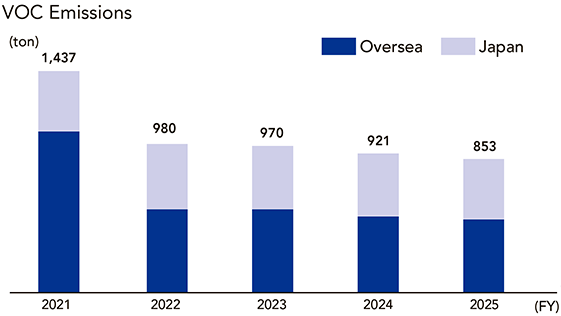
Volatile organic compounds (VOCs) can cause PM2.5 and photochemical smog, and curbing their emissions remains a challenge. As part of its efforts to minimize any impact on the environment surrounding our plants and on employees’ health, the Nitto Group is dedicated to reducing VOCs both in Japan and abroad. We will further promote solvent-free manufacturing through ultraviolet curing and water-based adhesives, while continuing to curb the use of hazardous substances in accordance with voluntary control standards, sustaining our efforts to reduce VOC emissions.
 |
The Nitto Group recognizes the sustainable use of water resources as a critical environmental issue and is committed to their conservation. To this end, we conduct water resource surveys and risk assessments at all our sites worldwide.
We are actively working to reduce water intake through efficient usage practices, including water recycling and continuous evaluation of water consumption. In response to water-related risks such as pollution and water stress, we have established monitoring and surveillance systems to prevent the discharge of pollutants and ensure compliance with environmental standards.
Furthermore, we contribute to society by promoting water recycling through membrane separation technologies. These efforts help conserve freshwater ecosystems, provide safe water for local communities, and prevent environmental degradation.
Water used in manufacturing processes can significantly impact local water sources. Excessive water withdrawal and pollution pose risks to ecosystems and local communities.
The Nitto Group recognizes the importance of managing these water-related risks and places strong emphasis on monitoring and managing water resources at its manufacturing sites.
Specifically, we continuously monitor and evaluate both water usage (intake) and water quality. This is achieved through the use of external tools such as Aqueduct, which assesses flood, drought, and water resource conditions, as well as internal environmental performance data (EPD), including metrics such as water intake, water discharge, and Chemical Oxygen Demand (COD).
* For more details, please refer to Sustainability Data Book.
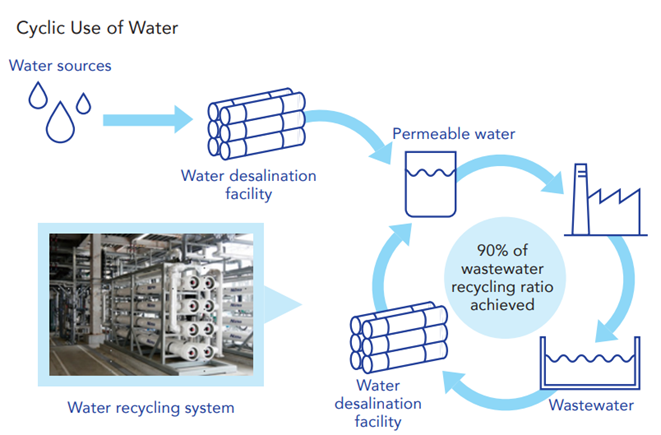
In addition to monitoring water intake, the Nitto Group is actively promoting water reuse and pursuing Zero Liquid Discharge (ZLD) to optimize water resource utilization and reduce the risk of operational disruptions caused by extreme weather and water scarcity.
At our Shiga Plant and Onomichi Plant, we use a water treatment technology employing the Nitto Group’s reverse osmosis (RO) membranes, which purify water by filtering out impurities, to recycle wastewater and effluents generated on site. At these sites, this technology enables the recycling of up to 90% of factory effluents.
Looking ahead, we plan to expand the deployment of our water treatment products and operational models—developed and validated in-house—particularly in developing countries and regions facing high water risk. By integrating these technologies with other environmental solutions, we aim to contribute to solving global challenges such as ensuring access to safe and reliable water and conserving water resources through our business activities.
 |
To promote environmental initiatives, the understanding and cooperation of every employee, including management, is essential. Therefore, we aim to continuously raise environmental awareness through educational programs focused on preventing air pollution, reducing waste, and using water resources efficiently in our business activities.
For any inquiries about Nitto.
Business Hours(Australia time)
8:30-17:00(Except for Sat, Sun, and Holidays)